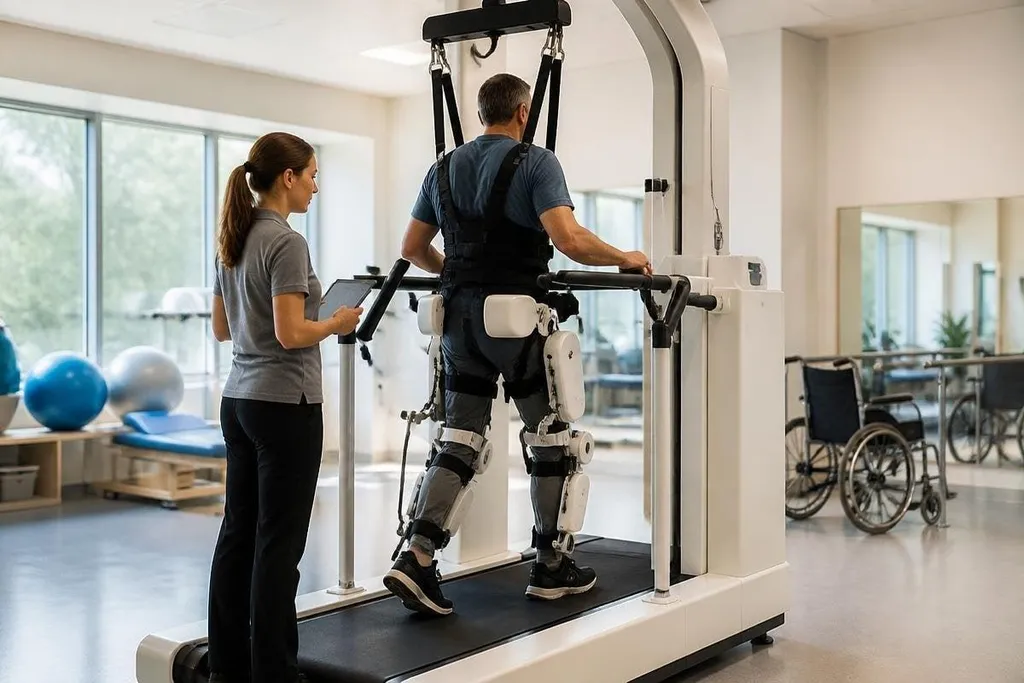
A rehabilitation robot can guide a person’s legs through repeated walking practice after a stroke, spinal cord injury, or other condition. It can reduce some of the physical work for the patient while a therapist watches movement, balance, and effort.
- Robots repeat steps at a set speed and path.
- Therapists can change how much help the patient receives.
- The machines support practice; they don’t predict who will walk independently.
What the robots actually do
Most walking rehabilitation robots fit into one of three groups. A treadmill system may support part of a patient’s body weight while motors guide the legs. An exoskeleton attaches to the legs and helps move the hip, knee, or ankle joints.
An end-effector system moves the feet from below, using footplates connected to robotic arms. Each design changes the task in a different way. Body-weight support can make standing safer during early practice.
An exoskeleton can help set the timing of each step. Footplate systems can guide a repeatable path while the therapist changes speed, step length, or how much weight reaches the floor.
That repeatability matters because walking practice takes many steps. A therapist can give hands-on help, but a robot can keep guiding the same movement after fatigue starts to change the patient’s form. The therapist still decides when to add effort, reduce support, or stop.
Where therapy may benefit
Walking after a neurological injury can involve several tasks at once: placing the foot, shifting body weight, keeping the trunk steady, and reacting to the floor. A robot can separate some of those tasks, then add them back as control improves.
The system may also record measures such as walking speed, step count, joint angle, and how much assistance the motors gave. Those figures can help a therapy team compare sessions. A higher step count alone doesn’t prove better recovery, since the patient may have needed more support to complete it.
A rehabilitation robot’s result needs the model, walking task, patient group, and trial date beside it. Robot24 can give a clinician that record, so the next question is whether the robot helps outside a supervised session.
The limits that matter
A robot can guide a leg, but it can’t copy every part of walking on a real floor. Turning, stepping around objects, changing speed, and recovering from a loss of balance all require control that may be harder to reproduce on a treadmill.
Fit also matters. The leg supports must match the patient’s body, and the joints need to line up with the machine’s axes. Poor fit can make movement uncomfortable or change the force placed on the knee, hip, or ankle.
Cost and access narrow the choices. These systems need trained staff, floor space, safety checks, and regular cleaning. A clinic may gain more from a device that therapists can set up quickly than from a machine with more sensors but a longer preparation time.
The evidence also needs careful reading. Guided practice may help a patient complete more guided steps during a session, yet that result doesn’t prove the person will walk farther without help months later. Outcomes depend on the injury, the therapy plan, the patient’s effort, and the time since the injury.
A practical guide for clinics and families
Use these checks before treating a rehabilitation robot as the right choice:
- Name the task: Decide if the need is early standing, repeated steps, balance work, or walking on ordinary ground.
- Check the support: Ask how the system limits or adds help as the patient’s strength changes.
- Measure the session: Record step count, walking speed, assistance level, and the patient’s response after treatment.
- Watch the fit: Confirm that leg supports and joint axes match the patient’s body without pain or pressure.
- Plan the next step: Ask how guided practice connects to walking with a cane, walker, or no device.
I’d choose the robot that gives the therapy team useful control and clear records, not the one with the longest feature list.
Rehabilitation robots can make walking practice more repeatable, but independent walking remains the test that matters. A clinic should judge the machine by what happens after the robot’s support is reduced.